

Jane Austen- Perception vs Reality
Updated: Sep 9
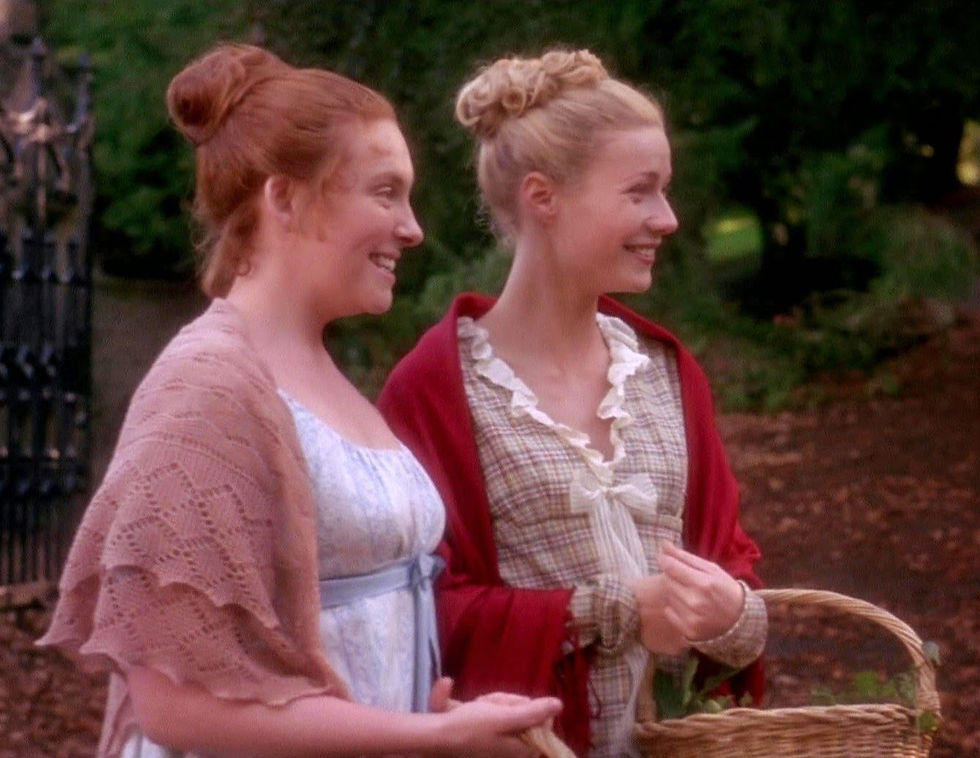
Misguided notions are a theme throughout Jane Austen’s novels. She was very observant of social positions because her family lived on the periphery of wealthier relatives and acquaintances. Propriety demanded people stay within their rank with occasional exceptions made for intelligent, resourceful women whose attractions allured suitors. Jane presents many amusing situations in which individuals blinded by initial perceptions abruptly encounter the shock of reality and are forced to reset their expectations. Readers have the fun of observing from afar the plights of characters plunging their way towards a major reality check. This has implications for friends, lovers, and parents.
Friends
Dear Emma was feeling abandoned and bored when she first met Harriet Smith and decided to make a project of finding her a husband despite her unknown family connections. Emma’s perception was that Harriet must be the daughter of a gentleman and encourages her to dismiss an offer of marriage from a local farmer, Robert Martin, whose sisters were her very good friends. Emma’s ambition is for Harriet to marry someone from a higher station in life, namely local clergyman, Mr. Elton. The chief objector to Emma’s matchmaking project is Mr. Knightly, her close friend and confidant. He considers her relationship with Harriet to be socially inappropriate. “You will puff her up with such ideas of her own beauty, and of what she has a claim to, that, in a little while, nobody within her reach will be good enough for her. Nothing so easy as for a young lady to raise her expectations too high……Men of sense, whatever you may chuse to say, do not want silly wives.”
He also warns Emma that Mr. Elton would never consider marrying someone beneath his station, especially a woman like Harriet of unknown origins. When her plot fails and Mr. Elton takes a wife, Emma turns her sights on Frank Churchill having already determined he was of no romantic interest to herself. Finally, Emma crashes headlong into reality when she realizes that Harriet’s true marital aspirations are focused on Mr. Knightly and were she to be successful, it would upend everything Emma holds dear. She had gone so far as to tease Knightly about Harriet. “Were you, yourself, ever to marry, she is the very woman for you.” Emma was forced to acknowledge her own feelings for Mr. Knightly and how much her behavior had contributed to the risk of losing him. In the end it was finally reveals that Harriet is not the daughter of a gentleman, she marries Robert Martin, and the trajectory of their lives diverge based on their status in society.
In Persuasion, vain Elizabeth Elliot chooses an inappropriate friendship with Mrs. Clay, the daughter of Sir Walter’s solicitor. Family friend, Lady Reynolds, is appalled to see this obsequious sycophant assert herself in their society at the expense of second daughter Anne. “From situation, Mrs. Clay was, in Lady Russell’s estimate, a very unequal and in her character, she believed a very dangerous companion – and a removal that would leave Mrs. Clay behind and bring a choice of more suitable intimates within Miss Elliot’s reach, was therefore an object of first-rate importance.”
Anne also recognizes the inappropriateness of her sister’s relationship with Mrs. Clay and the risk it presents to their family should Sir Walter’s interests in her turn romantic, a suggestion that is roundly dismissed by Elizabeth who values the presence of a flattering companion over the advice of her own sister. When the designated heir to their estate, William Elliot, arrives in Bath, he also observes the risk to his inheritance represented by Mrs. Clay. While Elizabeth flatters herself that his intention is courtship, his solution is to whisk Mrs. Clay away to London and set her up in an apartment at a safe distance from Sir Walter and Elizabeth whose vanity blinded them to the possibility that Mrs. Clay wanted anything more than to bask in the pleasure of their superior company.
Anne’s marriage and Mrs. Clay’s departure are an unwelcome reality check to her father and sister. “It cannot be doubted that Sir Walter and Elizabeth were shocked and mortified by the loss of their companion, and the discovery of their deception in her.” Elizabeth’s marriage prospects were also chastened. “It would be well for the eldest sister if she were equally satisfied with her situation, for a change is not very probable there. She had soon the mortification of seeing Mr. Elliot withdraw; and no one of proper condition has since presented himself to raise even the unfounded hopes that sunk with him.” Vanity is a deceptive companion for any woman.
(Intrigued by what happens to Elizabeth Elliot? I conjured a surprising marital solution for her in my novel, The Matchmaker of Pemberley, that I think you will find quite satisfying. Lizzy and Darcy travel to Bath and meet characters from all six novels resulting in three weddings and an engagement. Visit my homepage and download the first three chapters for free.)
Lovers
In Pride and Prejudice, we find two very different suitors with a shared love interest, namely, Miss Elizabeth Bennet. Both perceive themselves to be exemplary choices more than worthy of her acceptance and presume she will welcome a proposal of marriage and would, in fact, be grateful for it. Mr. Collins, designated heir to Mr. Bennet’s entailed estate, Longbourn, considers his willingness to seek out one of the five Bennet sisters as a wife to be a grand gesture and his conviction that he will be immediately embraced as God’s gift to the Bennet family aligns with his overall high opinion of himself and his station in life as the devoted acolyte of Lady Catherine de Bourgh.
His inflated ego and obsequious manner provide amusement to the family but the amusement fades when he singles out Lizzy as his choice and delivers an unwelcome proposal with all the confidence that her acceptance is assured. Perception clashes with reality when Lizzy spurns him, sending him directly into the arms of family friend, Charlotte Lucas, who welcomes his overtures and immediately accepts, thereby allowing his inflated sense of ego to avoid injury.
Mr. Darcy fairs no better when he finally succumbs to his feelings for Lizzy and proposes to her in an “ungentlemanlike manner”. His station in life and high opinion of himself brings with it assurances that anyone he deigns to marry will gratefully accept. His perception of Lizzy and the lowly connections of her family, allows him to presume she will welcome the proposal and overlook his behind-the-scenes interference with the relationship of his friend, Mr. Bingley, and Lizzy’s sister, Jane. He is unprepared for the reality check he receives from Lizzy about his own arrogant and insulting proposal, compounded by her anger over his treatment of Mr. Wickham and betrayal of Bingley and Jane. His attempts to justify his behavior in a letter to Lizzy have something of a positive impact but he still must wrestle with his own pride and prejudice before he can win her hand.
Mansfield Park presents wealthy, attractive young people mingling, flirting, assessing, and conspiring to secure eligible matches; all of them convinced they are deserving of their hearts’ desires. Only Fanny Price stands on the outside bearing witness to the mismatches based on the perceptions each reveal. Enter new arrivals Henry and Mary Crawford into the lives of the Bertram siblings, Tom, Edmund, Maria, and Julia.
Henry and Mary are rich and eligible with a fine opinion of themselves and their ability to influence others. A thoroughly modern Mary sets her sites on first-born Tom until she realizes he’s more interested in partying with his friends than pursuing her. She then sets her sites on Edmund despite the fact he is destined for the clergy, a profession for which she has little respect and expresses her distain openly: “A clergyman has nothing to do but to be slovenly and selfish – read the newspaper, watch the weather, and quarrel with his wife. His curate does all the work, and the business of his own life is to dine.” Her perception is she can persuade Edmund he would be happier married to her and living it up in London. He is completely smitten but still firm in his resolve to take on the family “living” and become a clergyman. Both are due for a reality check.
Henry Crawford is a man about town who enjoys wooing women without making a commitment. His flirtation with Maria Bertram who is already engaged, leaves her convinced that if he would only say the word, she would end her engagement. After he moves on, she follows through with her marriage to Mr. Rushworth and becomes the toast of London society.
Henry then decides the only woman he truly admires and loves is Fanny and he embarks on a relentless pursuit to convince her to marry him. Having long observed his flirtatious and inconstant behavior, she gives him a reality check by refusing him at the risk of displeasing her benefactor, Sir Thomas Bertram, and being sent back to her parents. While Henry is rejected by Fanny, he is embraced by Mrs. Maria Rushworth who runs off with him, plunging her family into a scandal and disrupting the romance between Edmund and Mary Crawford. The only one with a clear eyed view of the foibles she is witnessing is Fanny, but she is finally rewarded when Edmund realizes she is the woman he truly loves.
In Northanger Abbey, Isabella Thorpe fancies herself to be the object of great admiration and is always on the lookout for admirers. “Do you know there are two odious young men who have been staring at me this half hour,” and later, “They are not coming this way, are they? I hope they are not so impertinent as to follow us. Pray let me know if they are coming.” She is in the marriage market and wastes no time becoming engaged to James Moreland after he and her brother, John, arrive in Bath. When it turns out it will be a lengthy engagement, she begins a flirtation with Captain Tilney only to have him later spurn her at the price of her engagement to James. Her reality check comes at quite a cost because a broken engagement besmirches the woman’s reputation far more than the man’s.
Parents
In Sense and Sensibility, Mrs. Dashwood is so eager for the happiness of her second daughter, Marianne, and delighted with the attentions Mr. Willoughby is paying to her, she presumes they are engaged without verifying it with her daughter, restraining her overt behavior, or questioning the intentions of Willoughby. When his aunt sends him away, poor Marianne is devastated and when he rejects her overtures later in London, she realizes she has been made the fool when he chooses marriage to a wealthy woman over her. Everyone had been taken in by the perception of Willoughby as an eligible, amiable gentleman with charming manners and a good reputation except for Colonel Brandon, who knew he was guilty of seducing and abandoning the young ward under his protection. Both Mrs. Dashwood and Marianne must face their own poor judgement and lack of propriety in embracing an unworthy suitor.
Mrs. Ferrars has the wrong perception of both of her sons. A controlling mother whose expectations for Edward as the heir to her estate far exceed the reality of his natural inclinations and personal values. “He was neither fitted by abilities nor disposition to answer the wishes of his mother and sister, who longed to see him distinguished” (perhaps in Parliament), while all Edward’s “wishes centered in domestic comfort and the quiet of a private life.” When she finds out about his secret engagement to Lucy Steele, she disowns him in favor of her son, Robert who is rewarded with an estate. Then comes her reality check. Rather than being able to control Robert, he turns around and marries the conniving Lucy Steele after she breaks off her engagement with Edward, a fitting reality check for their controlling mother. Although they eventually reconcile, she misjudged them both, one for his principles and the other with none.
Northanger Abbey introduces us to General Tilney who rules his family with an iron fist. Misled into believing that young Catherine Moreland was an heiress, he arranges for her to be invited to the Abbey by his son, Henry, and daughter, Eleanor, who befriended the young lady when she first came to Bath. When he discovers the truth from John Thorpe, the same person who misled him, he banishes innocent, inexperienced Catherine from the Abbey in the middle of the night. His rush to judgement about her financial prospects and anger when the truth was revealed reflect his own bad judgement. Despite his efforts at domination, both Henry and Eleanor, manage to find happiness and Catherine Moreland gets her heart's desire.
We are all guilty of misperceptions at some point in our lives and forced to face reality, but Jane Austen makes it so entertaining when she uncovers the foibles of human nature to reveal universal truths that are so relatable in contemporary life.
Thank you for reading my blog. If you enjoyed my writing, please consider reading my two Jane Austen sequels. If you’re interested, you can download the first three chapters for free on my website homepage at www.catherinehemingway.com


I wrote a sequel in which it was suggested that Elizabeth Elliot and Penelope Clay had a lesbian relationship, hence the desire to have Mrs. Clay go to Bath.